
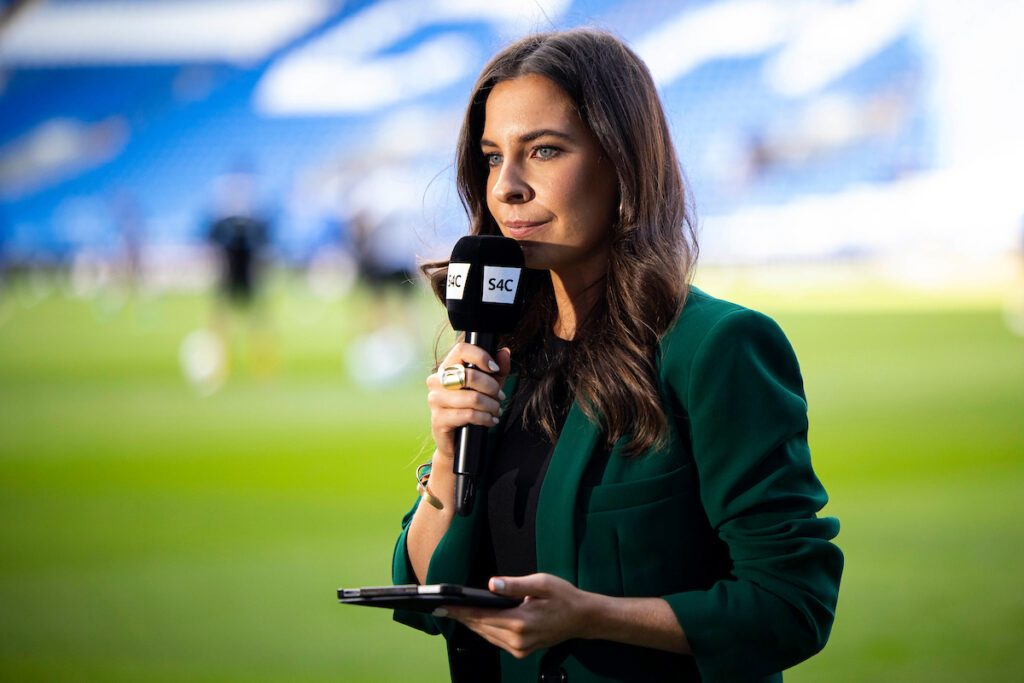
Sioned Dafydd has become one of Cymru’s most-recognisable presenters and reporters, covering both the domestic and international game for Sgorio.
To celebrate International Women’s Day, we spoke to her about her career to date and the challenges she has faced along the way.
“I have to say I feel like I’ve been very, very fortunate with my experiences,” Sioned explained when asked about her initial acceptance into a traditionally male-dominated industry.
“I’ve always been surrounded with incredibly supportive male colleagues, and I definitely owe them a lot. Not once have I been made to feel inferior or unwelcome. I’m very, very grateful for that even now after doing this job for the best part of seven years. It’s something that’s not lost on me at all.”
Sioned’s route in to football media
Now 28, Sioned’s story began studying Welsh as an undergraduate at Bangor University before completing her master’s degree in Sports Broadcasting at Cardiff Met. A work placement at Swansea City assisting the media department provided the perfect platform for the life-long Swans fan, and when they were relegated from the Premier League in 2018, the opportunity to stream their games live offered Sioned her first presenting role on the club’s official channels.
“I definitely have the Swans to thank for my passion for football,” she added. “Specifically the season when Michael Laudrup came in as manager (in 2012). We had Michu, I adore Michu, and that brilliant UEFA Europa League campaign a year later.
“My dad had taken me to watch them since I was a little girl at the Vetch, but I had never considered football as a job. However, seeing Swansea doing so well in the Premier League, and having that European campaign, it really ignited this idea.
“I would go and buy the Evening Post newspaper, read all the articles about the Swans, cut them up and put them in a little box. I’d spend hours just watching interviews with the players.
“I remember watching Fran Donovan back in the day doing really nice interviews on the club’s YouTube channel, and I just remember thinking that chatting with my favourite players would be quite a cool job. That’s definitely where where it all started for me and where it came from.
“One core memory I have is when I went to my very first Swansea City press conference. I actually won a competition when I was in sixth form to spend a week with the sports department at the Evening Post.
“Gareth Vincent was working for them at the time and he took me to the first press conference of the season, it was honestly the most exciting day of my life! I’ve ever been so excited! I was one of three women in the entire press room though, and that immediately stood out to me.”
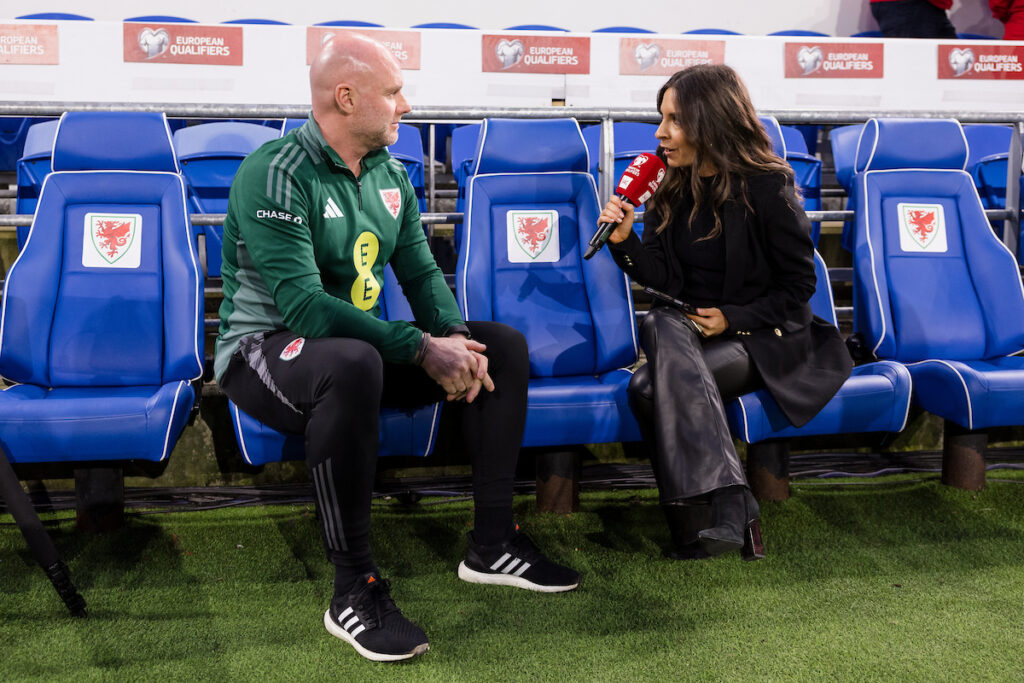
It was in 2021 and the post-pandemic return of football that saw Sioned take up her current role with Rondo Media and with it become part of the Sgorio team on S4C. “It’s the old cliche of if you can see it, you can be it,” she explained.
“People don’t realise that S4C were trailblazers back in the day for having women at the forefront of their football and rugby coverage. I remember watching the Six Nations as little girl and seeing the likes of Dot Davies and Eleri Siôn pitchside.
“Sgorio was the first football programme in Europe that had a female presenter in Amanda Protheroe-Thomas. I think that’s something that doesn’t get the recognition or credit it deserves because women have always been at the forefront of their sports coverage.
“Sgorio definitely played a massive part for me, just in terms being able to watch these women on screen when I was much, much younger.”
Recognition from the British Sports Journalism Awards
Now with significantly more female representation across the sporting media landscape, Sioned is more than holding her own in an increasingly competitive industry. This week, she was included on the shortlist by the SJA British Sports Journalism Awards for the ‘Ones to Watch – On Air’ award.
“You don’t want to overly rely on praise from other people,” she explained. “But getting that nomination, that recognition outside of the bubble of Welsh football, definitely changed something and really has given me a boost of thinking I know I can do this.
“I’ve definitely got to a point, and this has only happened in probably the last 12 months, where I now back myself and I have the confidence and that self-belief to tell myself that I am good at my job.
“I have the knowledge, I have the skills and I’m able to get very good interviews out of people. I think it took me a while because I was 24 when I started covering Wales, which is young, and I just remember thinking ‘what am I doing here?’ I was so young and inexperienced and there were other reporters with me that had actually been doing this job since I was in nappies.
“I still had so much more to learn, so much more to grow, but looking back I’m really proud of how I’ve grown because I had to grow up on camera as well. It’s the kind of job you where you can’t replicate anything, you can’t really practice.
“The only way you can get better is by doing it. I’m not perfect and I get criticised, but the thing is the person that’s hardest on me, is me. I give myself such a hard time because I want to be up there with the best, and hopefully the work I’m doing at the moment will get me there.”
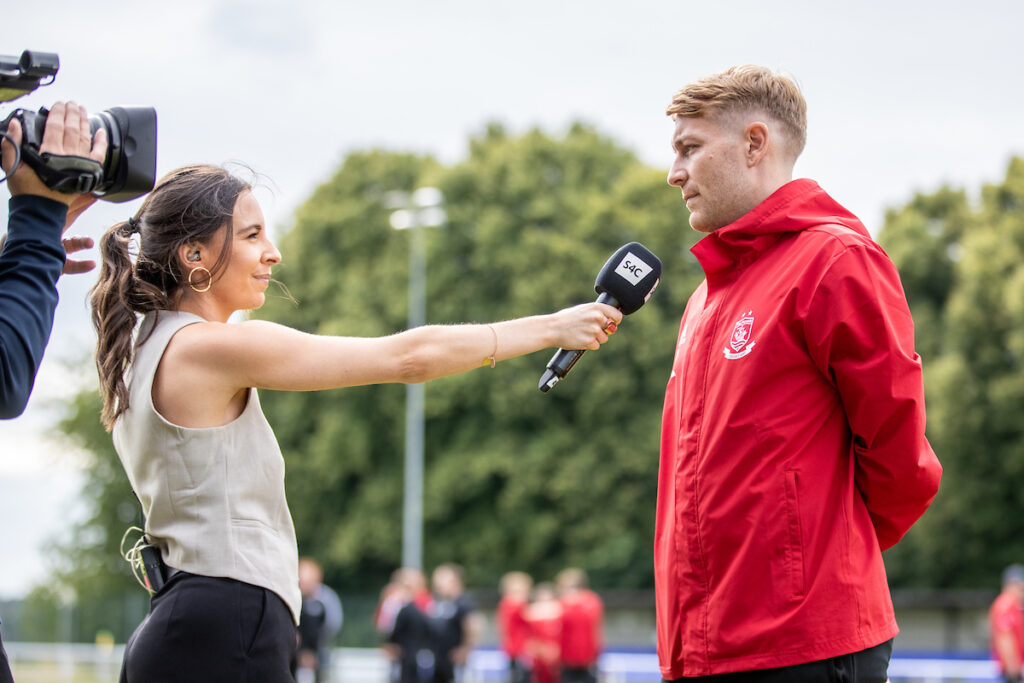
Being in the public eye can be difficult in the modern world, especially when social media turns toxic and keyboard warriors decide to vent their frustration.
“I’ve received negative traction on social media,” Sioned explained. “I’m human and I’d be lying if I said it didn’t affect me.
“When you’re met with people telling you you’re not very good at your job it’s not a nice feeling. I don’t want to say it comes with the territory because it’s not acceptable. I’m only human at the end of the day.
“Football is such an emotional game and when fans are upset and agitated they want to take it out on the manager or the players, but they can’t because they don’t have access to them.
“The only person they have access to is me, and they see me standing there on TV holding a microphone, so all of a sudden I’m the first in the firing line.
“It’s not nice, and my heart really goes out to people who suffer with it. I’ve had to develop a thick skin, because otherwise I think I would have lost my mind a few years ago.”
For someone with a genuine passion for the game, there was an immediate answer when Sioned was asked for her career highlight to date.
“The World Cup!” she enthused. “I’d been with Sgorio for about 18 months and I never thought that in such a short space of time I’d be flying out to Qatar. It was just the biggest privilege.
“Things didn’t go to plan on the pitch, but to be there covering Wales at World Cup for the first time since 1958, I’m not joking when I say I think about it on a daily basis. I still pinch myself, but it happened.”
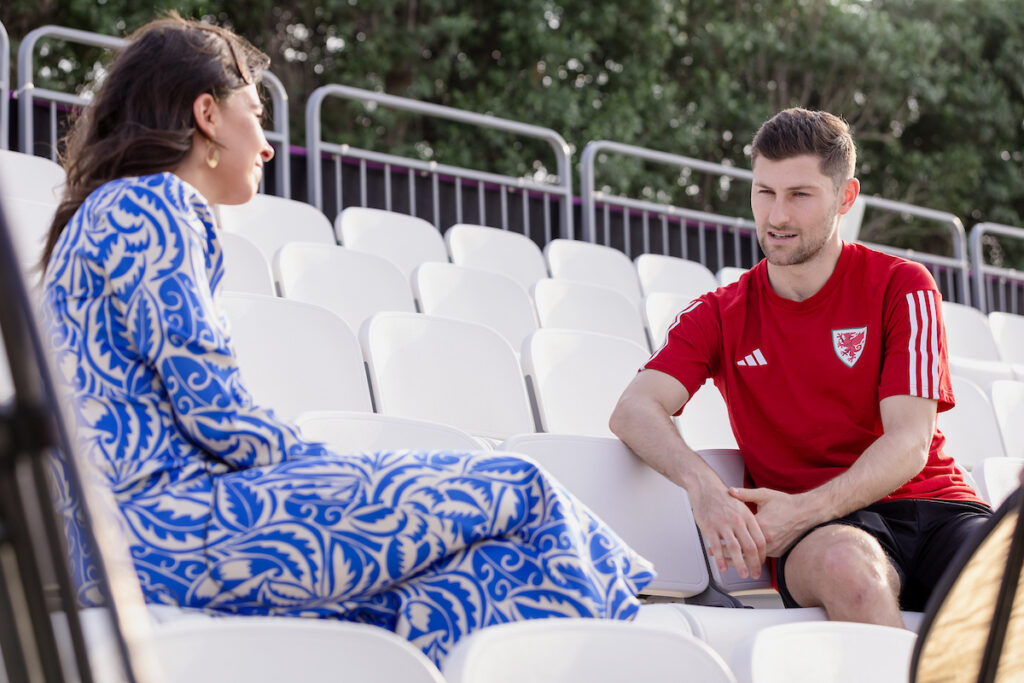
“I remember I was in University for EURO 2016, a skint student going down the pub to watch the games on TV and seeing Dylan Ebenezer and Owain Tudur Jones presenting, people who I looked up to at the time who are now my colleagues.
“I just remember thinking that’s what I want to do, and I’m going to be there one day. Life has a funny way of working out. I’m the kind of person that once I set my mind on something, I have this determination, and I won’t stop until I get it. So being stubborn has definitely helped!”
Finally, we asked Sioned for her advice to the those looking to follow her path.
“To anyone reading this, if you’ve got any sort of self-doubt, or if you think your ambitions are too big or too silly, don’t be afraid to set ridiculous goals, because you never know what could happen.
“I’ve always been a highly motivated person and I think it’s the kind of industry where you have to be. You can’t just wait for things to happen to you, you have to go after things and you have to be proactive.”